Can a Pro Football Quarterback Get Up and Run Again Once He Has Gone Into a Slide
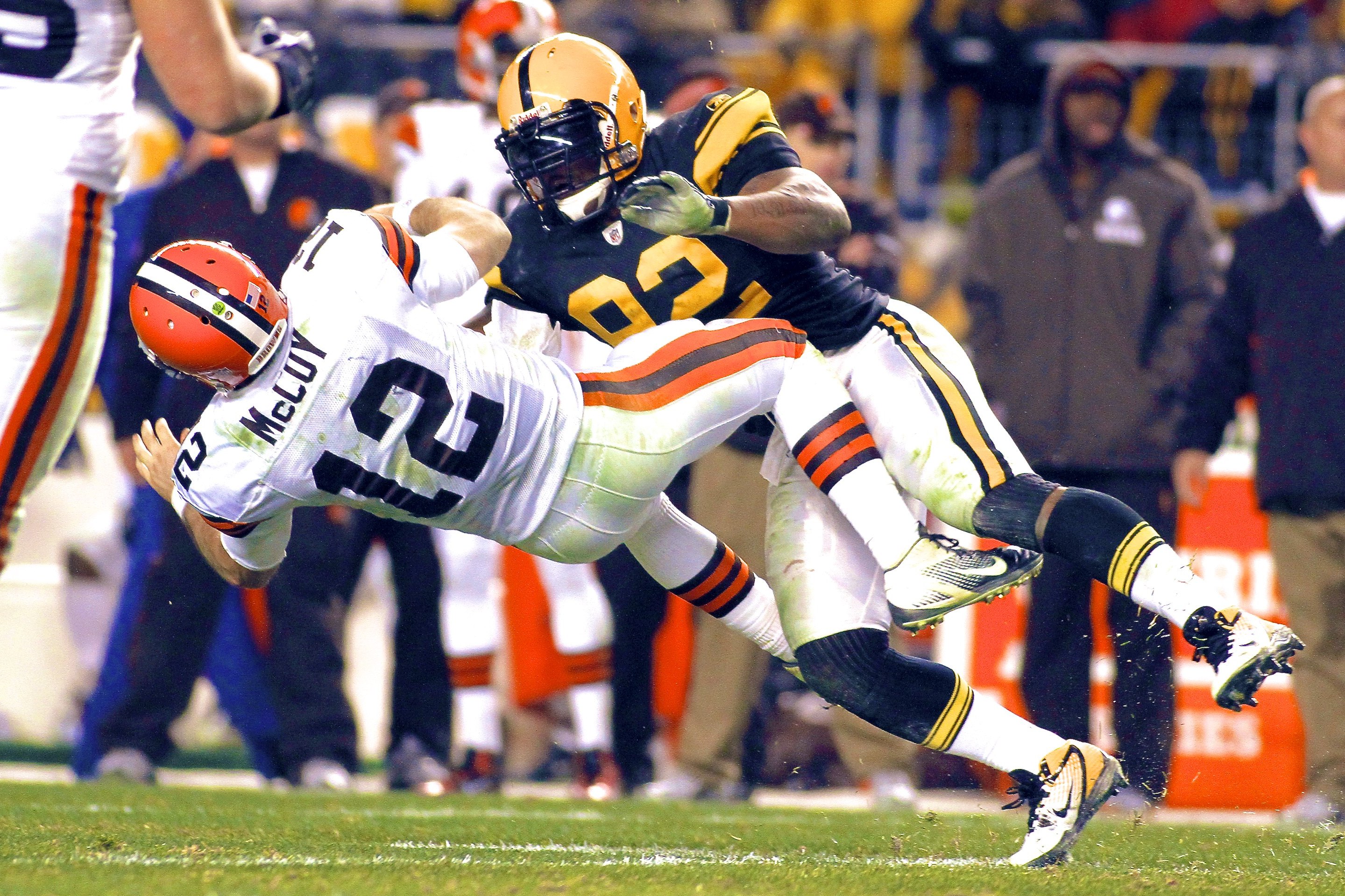
For the past couple of seasons, the National Football game League has been trying to make the game of football safer—at least, if one believes the NFL's side of the story.
Commissioner Roger Goodell has become known as the judge, jury and executioner of player punishment every bit he has presided over an increase in fines having to practice with actor safety. In a way, Goodell and the owners accept tried to legislate safe into an intrinsically unsafe game.
This, of course, happened at the same time as a now-settled lawsuit by thousands of former players who attested that the NFL purposefully deceived them on the long-term dangers of concussions and caput trauma in pro football game was being contested by the league.
If nil else, the renewed focus on safety has given the league something to highlight on the legal telestrator.
The "new" rules stem from before the 2011 season, when the NFL decided to protect what it considers caught players. At that fourth dimension, Ray Anderson—who serves as the NFL'southward executive vice president of football operations—told CBS Sports:
Frankly, now that the notice has been given, players and coaches and clubs are very aware of what the emphasis is and we won't have that hesitation. Anybody will be very conspicuously on notice now that a interruption is very viable for us and we volition exercise it ... when information technology comes to illegal hits to the head and cervix surface area and to defenseless players...
Rules defining a defenseless histrion were expanded to include eight categories:
- A quarterback in the act of throwing;
- A receiver trying to catch a pass;
- A runner already in the grasp of tacklers and having his forrard progress stopped;
- A player fielding a punt or a get-go;
- A kicker or punter during the kick;
- A quarterback at any time subsequently change of possession;
- A receiver who receives a bullheaded-side block;
- A player already on the ground.
This year, the NFL is adding notwithstanding some other wrinkle to the rulebook, outlawing offensive players from lowering the crowns of their helmets to ward off defensive players.
For someone who grew up in the "aureate era" of football, watching guys like San Francisco 49ers safety Ronnie Lott or Chicago Bears linebacker Mike Singletary dishing out hits, it's piece of cake to question whether the "good ol' days" accept come and gone.
Even so, it's more than a little quixotic to pretend as if the NFL is losing any followers as a result of its attempt to protect its players. It may brand some dice-hards pine for "better" days, but it'southward also coincided with the best TV ratings and fastest-ascension Telly dollars in the sport'south history. A purist might endeavor to argue that the integrity and passion of the game is more than of import than money, but I don't think the NFL owners are listening.
Quibble with the intent and necessity of the rules all you'd like (there's a cracking comment section below), but this column is intended to set one of my pet peeves. Rules are rules, and the players know the rules—or, at least, they should. Fans, on the other hand, rarely see the black and white of that matter, preferring to see the world in shades of gray with highlights of their favorite team's colors.
As Calendar week 1 starts and the season begins, hither is what illegal hits expect like in the NFL rulebook.
Illegal Hits on Quarterbacks
OK, we all empathise "roughing the passer," correct? But, did y'all know that roughing the passer accounts for an entire page in the NFL rulebook? In addition to hitting the quarterback after he has already thrown the ball, the rule encompasses: lunging at his knees, clubbing at his throwing hand and unnecessarily throwing him down with excess forcefulness.
Too from the rulebook under roughing the passer:
A defensive player must non use his helmet against a passer who is in a caught posture—for example, (1) forcibly striking the passer'due south caput or cervix area with the helmet or facemask, fifty-fifty if the initial contact of the defender's helmet or facemask is lower than the passer'southward neck, and regardless of whether the defensive player also uses his artillery to tackle the passer by encircling or grasping him; or (2) lowering the head and making forcible contact with the top/crown or forehead/"hairline" parts of the helmet confronting whatsoever part of the passer's trunk. This dominion does not prohibit incidental contact by the mask or not-crown parts of the helmet in the course of a conventional tackle on a passer.
It is, if nothing else, a whole lot of verbiage for the full general rule that we already know; "don't striking a quarterback in the head, or hard...similar, at all. It as well contains a whole lot of fine lines which can enrage both the players on the field and the fans at home.
Take this play by Detroit Lions defensive tackle Ndamukong Suh for example:
Suh is known equally a dirty player on the field. He was flagged here for a hit on Chicago Bears quarterback Jay Cutler, who allegedly received a forearm to the head. On replay, one can see that conspicuously didn't happen. And then, in reality, Suh was simply fined for being big, strong and a having a bad reputation.
The same could exist said for Washington Redskins linebacker London Fletcher'southward hitting on New England Patriots quarterback Tom Brady. Brady is the patron saint when it comes to referees protecting quarterbacks, so ane expects this kind of call when he'southward involved.
Then what is the NFL looking for from a defender? From the rulebook:
When tackling a passer who is in a defenseless posture (east.one thousand., during or just after throwing a pass), a defensive thespian must not unnecessarily or violently throw him down and state on meridian of him with all or nigh of the defender'southward weight. Instead, the defensive role player must strive to wrap upwards the passer with the defensive role player's arms.
At least, that is what referees are looking for. Does it get called properly every time? Of class not, then that's what fans and media should concur them accountable for.
Illegal Hits on Backs and Receivers
Running backs are the least protected players in all of football. While running the ball, it's assumed that high-speed collisions are going to be part of the equation. That said, there are nevertheless some rules for defenders to follow.
Starting time, tripping is normally something nosotros expect to be called on offensive players tripping upwards defenders (like to the leg-whip telephone call), just a defender on the ground who attempts to trip upward a runner rather than tackle him could be chosen for a penalty—even if that's what nosotros would logically await the defender to practise.
In that location is also striking a runner while he is out of bounds. This is often viewed as more than of a sentence call by the refs when information technology really isn't. The NFL rulebook clearly puts the onus on defensive players in these instances:
Defensive players must make an endeavor to avoid contact. Players on defense are responsible for knowing when a runner has crossed the boundary line, except in doubtful cases where he might step on a boundary line and continue parallel with it.
That's pretty clear, and gives far less do good of the doubt than many fans would probably like.
And then, we get to the aforementioned department of the rulebook. This prohibits any hits to the head of the runner or past the head of the defender on runners who do not have the power to defend themselves and/or are not in a defensive posture.
Once again, the burden of proof is placed on defensive players:
A player who initiates contact against a caught opponent is responsible for avoiding an illegal act. This includes illegal contact that may occur during the process of attempting to dislodge the brawl from an opponent. A standard of strict liability applies for any contact against a defenseless opponent, even if the opponent is an airborne actor who is returning to the ground or whose body position is otherwise in motion, and irrespective of whatsoever acts by the caught opponent, such as ducking his caput or crimper up his body in anticipation of contact.
Consider this hit by Chicago Bears linebacker Jon Bostic:
It was, at first, heralded past just about anybody every bit a bully play by the rookie linebacker. So, Bostic received his fine alphabetic character via FedEx and the NFL had to get around explaining exactly why it was illegal.
Again, it's a bang-bang play, and exactly the kind of effort and tenacity that coaches want to run across, but the rulebook says that Bostic has to brand sure that he'south not leading with his helmet.
Illegal Hits on Specialists
Alongside the rarely called penalty of sliding under the kicker or punter in order to prevent him from returning to the ground, well-nigh roughing-the-kicker or roughing-the-punter penalties occur because the defender has initiated contact with either the boot leg or the establish leg of the specialist.
At that place are some well-known caveats, however: A defender tin can exist blocked into the specialist, and the specialist can be held accountable for attempting to "draw" the foul by his own actions. Too, if the specialist attempts to run in any way—even to attempt a rugby-style kick or "quick kick"—he'due south fair game.
Special intendance is taken in regard to the plant leg, every bit that is the most defenseless body function of about whatsoever histrion on the football field. Consider the knee of the establish leg like a motorcar without shock absorbers. With all of the weight of the body on it, it is virtually as sturdy every bit a couple of twigs held together by a rubber band. A devious hit in that location tin can finish a kicker's career about instantly.
The rulebook gets right to the point in the concluding annotation: "When in uncertainty, it is a foul for roughing the kicker."
Other Illegal Hits on Players in Compromised Positions
Ane of the dirtiest hits in recent retention came on a play that is now illegal. Defenseless players are now protected after a modify in possession. Hither is Hall of Fame defensive tackle Warren Sapp bravado up Packers offensive tackle Chad Clifton:
At the time, this was legal a football play. Sapp didn't know which direction Clifton would move and whether he might make the eventual tackle, so Sapp played all out until the whistle—but like immature players are taught.
It's besides conspicuously a dangerous play, which is now against the rules.
Players are besides protected from blows to and from the caput during blindside blocks in which an offensive histrion is moving parallel to the line of scrimmage, as well equally illegal crack-back blocks in which the offensive player uses his head. Let'south but phone call this one the "Hines Ward Rule." Hither's Seattle Seahawks receiver Golden Tate beingness called for such an illegal block on Dallas Cowboys linebacker Sean Lee:
In addition, players are protected when they are already on the basis or in the human action of sliding; when they are already in the grasp of a tackler or when they are receiving a kicking or a punt. Once again, it's entirely upward to defenders to know all of these rules and to abide by them as the NFL seeks to brand the game a safer place.
That, in a nutshell, is the bottom line here. The NFL realizes information technology is impossible to make the game prophylactic—I don't recall Goodell or the owners are that deluded. No, simply safer is a possibility every bit the league attempts to move forward with new rules (along with new technology and new medical advances).
It isn't a popular goal, just it hasn't made the NFL whatever less popular, either, which means the new rules volition persist, the game will proceed to evolve, and defenders (and fans) need to take note.
Michael Schottey is the NFL National Pb Writer for Bleacher Report and a member of the Pro Football Writers of America. Notice more of his stuff at The Go Road.
Source: https://bleacherreport.com/articles/1760584-a-guidebook-for-nfl-hits-whats-legal-whats-not-whats-just-plain-dirty
Belum ada Komentar untuk "Can a Pro Football Quarterback Get Up and Run Again Once He Has Gone Into a Slide"
Posting Komentar