Sba Policies and Procedures Post Tenure Review Self Reflection Narrative
Welcome to the Council on Accreditation (COA) weblog mail series Profiles in Accreditation!
The organizations that COA accredits are various in both the communities they serve and their reasons for seeking accreditation (or reaccreditation). Profiles in Accreditation will explore the accreditation experience through the perspective of these organizations. Through them, we tin can detect the value of accreditation, best practices, lessons learned, and recommendations.
Arrangement profile
Name: Ranch Ehrlo Society
Locations: Regina, Prince Albert, Moose Jaw, Fort Qu'Appelle, and the Rural Municipalities of Edenwold, Corman Park, and Buckland, Saskatchewan, Canada
First accredited: 1977
Reaccredited: 2019
Snapshot: Ranch Ehrlo, a non-profit organization, was founded by the late Dr. Geoff Pawson in 1966. It started as a unmarried residential unit for 6 troubled boys and grew to a multi-service agency that serves thousands every year. Ranch Ehrlo offers a wide range of accredited mental health and developmental services on campuses located in and around Regina, Saskatoon, and Prince Albert, in the Canadian province of Saskatchewan. Its services include assessment and psychotherapy for members of the broader community, family treatment and reunification, early learning, vocational preparation, emergency receiving services, treatment foster intendance, affordable housing, residential treatment and teaching for children and youth with mental health and addictions needs, residential care for older adolescents and adults with pervasive and complex developmental disorders, and customs recreation and sports programs for at-risk youth. Clients are referred to Ranch Ehrlo from across the country.
Ranch Ehrlo's mission isto provide quality preventative and restorative services to, and advancement for, vulnerable individuals and families through highly engaged and professional employees. Itenvisions communities where all individuals and families attain their full potential.
Ranch Ehrlo is guided by the Care model, Children And Residential Experiences: Creating Conditions for Change. Developed by Cornell University, Intendance is a multi-level program aimed at improving services for children and youth in care. Based on vi guiding principles (developmentally focussed, family involved, human relationship based, trauma informed, competence centred, and ecologically oriented) the CARE model is designed to significantly influence the way professionals piece of work with children.
Interview with Ranch Ehrlo Lodge
For this Profiles in Accreditation post, we asked Ranch Ehrlo President and CEO Andrea Brittin to share her experience of the COA accreditation process at a large organisation that dedicated itself to becoming accredited not because of a mandate, but because of a passion for best practices. Ms. Brittin emphasized how accreditation has encouraged growth and enhanced cohesion beyond the agency.
* * *
COA: Why was seeking initial accreditation important for your organization?
AB: In the early 1970's, Ranch Ehrlo Order sought to obtain accredited membership with the Child Welfare League of America (CWLA) to assist in the evolution of sound policies, procedures, and standards of practice. Equally the CWLA was one of the founding members of COA, information technology was a natural progression for u.s. to seek accreditation from this body to validate our effectiveness and keep abreast of the latest in research and all-time practice.
COA: What were some of the drivers for seeking reaccreditation?
AB: Ranch Ehrlo Societystrongly believes that maintaining best exercise, as well as continual self-assessment, aids quality comeback and rejuvenates the agency. This benefits both those we serve and bureau personnel. Undergoing the process of reaccreditation demonstrates that we, as an organisation, continue to finer manage our resources, assuasive us to accomplish our goals. The reaccreditation process is one of many strategies we employ to help in stabilizing, measuring, and validating our effectiveness, ensuring that we are kept highly informed of the latest research and practice in the human being services field. Our organization has grown exponentially since we were first accredited more than xl years ago, and so it is essential to accept a method of review in place to be sure all elements are functioning smoothly.
COA: What about the COA accreditation process made y'all decide to partner with u.s.a.?
AB: For clients and participants, COA accreditation demonstrates:
- Best practices carried out by accordingly trained staff.
- Client participation in their own service planning.
- A safe and respectful environment.
- Privacy protections of their confidential information.
- Positive outcomes.
- Cultural competence.
For employees, it demonstrates:
- Focus on wellness and safety with minimized risks.
- Efficient, constructive, and supported environments. Divers professional staff qualifications. Performance evaluation and employee evolution in a civilisation of excellence.
For the lath, it demonstrates:
- Sound financial management.
- Ethical practices.
- Current, relevant, and monitored strategic plan. Effective operation, quality improvement and risk management systems.
- Policies and procedures address pertinent issues.
For Funders and Referral Agencies, it demonstrates:
- Validation of high-quality services.
- Audio financial practices.
- Performance and quality comeback.
- Efficient organizational operations.
- Effective hazard direction policies.
COA: Were there whatsoever unexpected results afterwards completing the Self Report and PQI process?
AB: We are very proud that COA standards and expectations accept been engrained in the cloth of Ranch Ehrlo Social club. New quality improvement initiatives, procedure developments, or procedure amendments are not undertaken "for COA". These tasks are welcomed, every bit they are a testament to the value the agency places on continuous improvement. Although self-test is not always elementary, particularly when obstacles are presented, the agency has learned to savour the challenge, with the solid best-do framework and back up COA offers. Comfort with cocky-reflection is an organizational shift from previous accreditation cycles.
COA: How did yous engage and communicate the value of accreditation to the entire organization during the accreditation process?
AB: A squad of subject matter experts was appointed to each of the 21 sections/sub-sections of standards assigned to Ranch Ehrlo. These teams, in tandem with the quality improvement section, examined the standard implementation required and orchestrated the collection of testify. This approach immune investment in the procedure by a greater population of personnel.
Throughout the year leading upwardly to the Self Report submission and Site Visit, advice to agency employees was ongoing. Emails, website stories, standing agenda items at departmental or program meetings, etc.–all worked simultaneously to ensure staff were informed and engaged.
All agency employees, regardless of position, programme, or location, had the opportunity to partake in the procedure. There are various ways this occurred – from composing a written narrative, to offering input for policies in evolution, to being informally interviewed or observed during the Site Visit, to learning nearly the process through agency communications. This provided a sense of ownership in the agency's intentions and functioning.
COA: What practise you see as the main do good of COA accreditation?
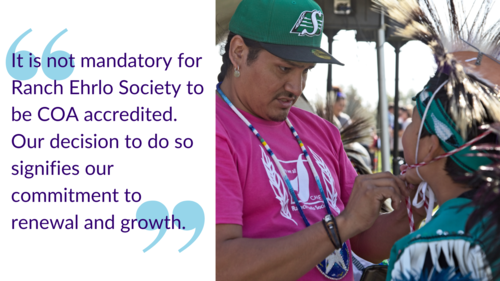
AB: We at Ranch Ehrlo strongly believe that adhering to best practices, besides as continual evaluation, helps us enhance our services for the young people, adults, and families we serve. For that reason (and many more than), we cull to pursue accreditation equally a means to periodically and thoroughly review EVERYTHING we do. It is not mandatory for Ranch Ehrlo Order to be COA accredited. Our conclusion to practice and so signifies our commitment to renewal and growth. COA offers extremely thorough training, documentation, and support throughout the procedure, so, although accreditation is a corking deal of work, guidance was always bachelor.
COA: What well-nigh the accreditation procedure do you feel was most valuable to your organisation?
AB: The self-study process is always a valuable opportunity for reflective practice and learning. In the past, it has proven so impactful and valuable for staff to hear the comments of Peer Reviewers at the Exit Meeting, and to read near strengths and areas for comeback in the Concluding Accreditation Written report.
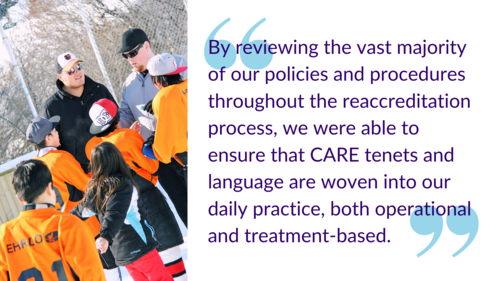
Also, Ranch Ehrlo Society has been in the process of implementing the Care (Kid and the Residential Experience) Model of handling over the last 2 years. All agency employees, regardless of role, tenure or location, have been or will be trained in the model, and continual training is offered to direct-care staff. By reviewing the vast bulk of our policies and procedures throughout the reaccreditation process, we were able to ensure that CARE tenets and linguistic communication are woven into our daily do, both operational and handling-based.
COA: What did you like most about the accreditation process?
AB: Information technology is a collaborative procedure that requires numerous departments, programs and personnel to work closely to review policies and procedures and to evaluate the caste of standard implementation. By engaging collectively with colleagues, a cross-section of staff from a variety of areas were reviewing information, so processes were examined more than thoroughly and nether a variety of lenses. This led to a greater understanding and appreciation of the organizations' functioning, allowing for enhanced cohesion.
The Site Visit was too extremely beneficial, as information technology provided existent-time advice and feedback from the Peer Reviewers and gave employees a face-to-face connexion with COA. The visit allowed us to demonstrate our successes, just we were also not afraid to have our challenges highlighted. This truly allows for cogitating practice and growth.
COA: What was the biggest challenge during the accreditation process?
AB: Ranch Ehrlo Society is a large system, with close to 900 employees working in dozens of programs and locations beyond the province of Saskatchewan. We were assigned 21 different sections of standards and submitted over 1000 documents for our Self Report. There was a great bargain of organization and communication required to coordinate review teams and bear witness.
COA: How has COA (re)accreditation impacted operational success?
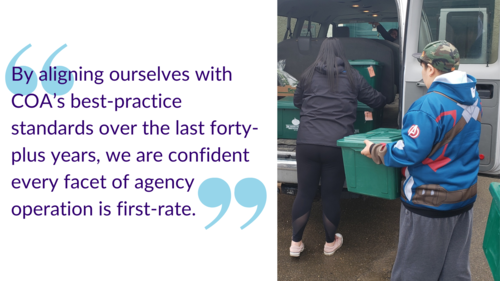
AB: Ranch Ehrlo Society firmly believes that accreditation improves the overall quality of care for those nosotros serve. By aligning ourselves with COA'due south best-practice standards over the final xl-plus years, we are confident every facet of agency operation is kickoff-rate. COA has given us the opportunity to strengthen our continuous comeback efforts and raise our programming, while establishing a highly-competent workforce and supporting our mission. The procedure makes us more cognizant of proactively reviewing and, if required, revising policies and procedures and other agency operations.
COA: What are the top iii pieces of advice or tips that yous would requite to an arrangement considering or currently undertaking the accreditation process for the first time?
AB:
- Be sure to give yourself PLENTY of time to ready for each phase of the process. Some required documentation or processes will already be, but many others will have to be revised or created. Set due dates well in advance of last submission deadlines. It may take much longer than you anticipate preparing evidence and implement procedures. Carve out time in your daily agenda to consummate COA-based tasks. This volition keep you on schedule.
- Thoroughly review the standards prior to beginning the implementation review and document collection process, noting where information is required from a cross-section of departments. For example, the Residential Treatment Services Standards (RTX) may be the focus for employees working in those programs, only they volition likely require collaboration with Human Resources for staffing lists, preparation information, etc. This volition avoid scrambling for bear witness when due dates approach.
- Depending on the size of your organization, the Stakeholder Survey process may be a much larger project-within-a project than anticipated. Collecting the contact data and engaging the assistance and input of hundreds of stakeholders across the country was a challenge for our bureau.
COA: Are there any other learnings or insights that you lot'd similar to share?
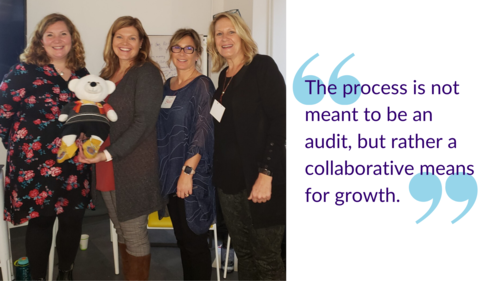
AB: Fully embrace the accreditation process. It is non easy, and information technology extremely time consuming, only information technology is all worth it in the end. Delve into the COA-offered trainings, both in-person and online and connect regularly with your accreditation coordinator with COA. The procedure is non meant to be an audit, but rather a collaborative ways for growth in an organization. Do not be afraid to highlight areas of claiming or where comeback is required. That is the intention of the process. No organization is perfect, just accreditation tin can assist each organisation in living up to their full potential.
Give thanks you, Ranch Ehrlo Club!
Nosotros would like to express our gratitude toward Ms. Brittin for her inspiring insights and tips and acknowledge the entire Ranch Ehrlo team for embracing accreditation and collectively contributing to the promotion of best practices. Thank yous, all!
Do yous have a COA accreditation story to tell? Click here to share it. You lot could exist the adjacent system we characteristic!
Source: https://coanet.org/2020/03/profiles-in-accreditation-ranch-ehrlo-society/
Belum ada Komentar untuk "Sba Policies and Procedures Post Tenure Review Self Reflection Narrative"
Posting Komentar