Famous Early Mathematicians 1st Art Gallery 1st Art Gallery



Rencontre dans la porte tournante by Man Ray, 1922, with helix
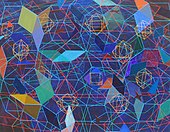


"Angel V" of Mikołaj Jakub Kosmalski - A cubic bend formed on a finite set of points generated by a parametric formula using trigonometric functions and operations on circuitous numbers.
This is a list of artists who actively explored mathematics in their artworks.[3] Fine art forms practised by these artists include painting, sculpture, architecture, textiles and origami.
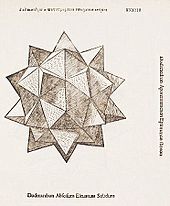
Some artists such equally Piero della Francesca and Luca Pacioli went so far as to write books on mathematics in art. Della Francesca wrote books on solid geometry and the emerging field of perspective, including De Prospectiva Pingendi (On Perspective for Painting), Trattato d'Abaco (Abacus Treatise), and De corporibus regularibus (Regular Solids),[4] [v] [vi] while Pacioli wrote De divina proportione (On Divine Proportion), with illustrations by Leonardo da Vinci, at the end of the fifteenth century.[7]
Merely making accepted utilise of some aspect of mathematics such as perspective does not qualify an artist for admission to this list.
The term "fine art" is used conventionally to embrace the output of artists who produce a combination of paintings, drawings and sculptures.
List [edit]
| Artist | Dates | Artform | Contribution to mathematical art |
|---|---|---|---|
| Calatrava, Santiago | 1951– | Compages | Mathematically-based compages[3] [8] |
| Della Francesca, Piero | 1420–1492 | Fine fine art | Mathematical principles of perspective in art;[nine] his books include De prospectiva pingendi (On perspective for painting), Trattato d'Abaco (Abacus treatise), and De corporibus regularibus (Regular solids) |
| Demaine, Erik and Martin | 1981– | Origami | "Computational origami": mathematical curved surfaces in cocky-folding paper sculptures[10] [11] [12] |
| Dietz, Ada | 1882–1950 | Textiles | Weaving patterns based on the expansion of multivariate polynomials[thirteen] |
| Draves, Scott | 1968– | Digital art | Video art, VJing[xiv] [15] [sixteen] [17] [eighteen] |
| Dürer, Albrecht | 1471–1528 | Fine fine art | Mathematical theory of proportion[xix] [20] |
| Ernest, John | 1922–1994 | Fine art | Use of group theory, cocky-replicating shapes in art[21] [22] |
| Escher, Thou. C. | 1898–1972 | Fine art | Exploration of tessellations, hyperbolic geometry, assisted by the geometer H. Due south. M. Coxeter[19] [23] |
| Farmanfarmaian, Monir | 1922–2019 | Fine fine art | Geometric constructions exploring the infinite, especially mirror mosaics[24] |
| Ferguson, Helaman | 1940– | Digital fine art | Algorist, Digital creative person[3] |
| Forakis, Peter | 1927–2009 | Sculpture | Pioneer of geometric forms in sculpture[25] [26] |
| Grossman, Bathsheba | 1966– | Sculpture | Sculpture based on mathematical structures[27] [28] |
| Hart, George Due west. | 1955– | Sculpture | Sculptures of iii-dimensional tessellations (lattices)[3] [29] [30] |
| Radoslav Rochallyi | 1980– | Fine art | Equations-inspired mathematical visual fine art including mathematical structures. [31] [32] |
| Loma, Anthony | 1930– | Fine fine art | Geometric abstraction in Constructivist art[33] [34] |
| Leonardo da Vinci | 1452–1519 | Fine art | Mathematically-inspired proportion, including golden ratio (used every bit golden rectangles)[nineteen] [35] |
| Longhurst, Robert | 1949– | Sculpture | Sculptures of minimal surfaces, saddle surfaces, and other mathematical concepts[36] |
| Human being Ray | 1890–1976 | Fine art | Photographs and paintings of mathematical models in Dada and Surrealist art[37] |
| Naderi Yeganeh, Hamid | 1990– | Fine art | Exploration of tessellations (resembling rep-tiles)[38] [39] |
| Pacioli, Luca | 1447–1517 | Fine art | Polyhedra (east.g. rhombicuboctahedron) in Renaissance art;[19] [twoscore] proportion, in his book De divina proportione |
| Perry, Charles O. | 1929–2011 | Sculpture | Mathematically-inspired sculpture[three] [41] [42] |
| Robbin, Tony | 1943– | Fine art | Painting, sculpture and computer visualizations of four-dimensional geometry[43] |
| Saiers, Nelson | 2014– | Art | Mathematical concepts (toposes, Brown representability, Euler'south identity, etc) play a central role in his artwork.[44] [45] [46] |
| Sugimoto, Hiroshi | 1948– | Photography, sculpture | Photography and sculptures of mathematical models,[47] inspired by the work of Man Ray [48] and Marcel Duchamp[49] [50] |
| Taimina, Daina | 1954– | Textiles | Crochets of hyperbolic space[51] |
| Uccello, Paolo | 1397–1475 | Art | Innovative utilize of perspective grid, objects every bit mathematical solids (due east.grand. lances as cones)[52] [53] |
| Kosmalski, Mikołaj Jakub | 1986 | Digital art | Exploration of spreadsheet software capabilities (OO Calc and MS Excel), generation of finite sets of points by parametric formulas, connecting these points by curved (usually cubic) and broken lines.[54] |
| Verhoeff, Jacobus | 1927–2018 | Sculpture | Escher-inspired mathematical sculptures such as lattice configurations and fractal formations[three] [55] |
References [edit]
- ^ Benford, Susan. "Famous Paintings: The Battle of San Romano". Masterpiece Cards . Retrieved viii June 2015.
- ^ "Mathematical Imagery: Mathematical Concepts Illustrated by Hamid Naderi Yeganeh". American Mathematical Society. Retrieved 8 June 2015.
- ^ a b c d e f "Monthly essays on mathematical topics: Mathematics and Art". American Mathematical Society. Retrieved vii June 2015.
- ^ Piero della Francesca, De Prospectiva Pingendi, ed. G. Nicco Fasola, 2 vols., Florence (1942).
- ^ Piero della Francesca, Trattato d'Abaco, ed. K. Arrighi, Pisa (1970).
- ^ Piero della Francesca, L'opera "De corporibus regularibus" di Pietro Franceschi detto della Francesca usurpata da Fra Luca Pacioli, ed. G. Mancini, Rome, (1916).
- ^ Swetz, Frank J.; Katz, Victor J. "Mathematical Treasures - De Divina Proportione, by Luca Pacioli". Mathematical Clan of America. Retrieved vii June 2015.
- ^ Greene, Robert. "How Santiago Calatrava blurred the lines between architecture and engineering to make buildings move". Arch daily. Retrieved vii June 2015.
- ^ Field, J. 5. (2005). Piero della Francesca. A Mathematician's Art (PDF). Yale University Press. ISBN0-300-10342-v.
- ^ Yuan, Elizabeth (2 July 2014). "Video: Origami Artists Don't Fold Under Force per unit area". The Wall Street Journal.
- ^ Demaine, Erik; Demaine, Martin. "Curved-Crease Sculpture". Retrieved 8 June 2015.
- ^ "Erik Demaine and Martin Demaine". MoMA. Museum of Modernistic Art. Retrieved 8 June 2015.
- ^ Dietz, Ada K. (1949). Algebraic Expressions in Handwoven Textiles (PDF). Louisville, Kentucky: The Niggling Loomhouse. Archived from the original (PDF) on 2016-02-22. Retrieved 2015-06-07 .
- ^ Birch, K. (20 August 2007). "Cogito Interview: Damien Jones, Fractal Artist". Archived from the original on 27 August 2007. Retrieved vii June 2015.
- ^ Bamberger, A. (2007-01-18). "San Francisco Fine art Galleries - Openings". Retrieved 2008-03-11 .
- ^ "Gallery representing Draves' video art". Archived from the original on 2008-06-06. Retrieved 2008-03-xi .
- ^ "VJ: It'southward not a affliction". Keyboard Mag. April 2005. Archived from the original on 2008-04-12. Retrieved 2015-06-08 .
- ^ Wilkinson, Alec (2004-06-07). "Incomprehensible". New Yorker Mag.
- ^ a b c d "Feature Column from the AMS". American Mathematical Society. Retrieved vii June 2015.
- ^ "Albrecht Dürer". University of St Andrews. Retrieved seven June 2015.
- ^ Beineke, Lowell; Wilson, Robin (2010). "The Early History of the Brick Factory Problem". The Mathematical Intelligencer. 32 (2): 41–48. doi:x.1007/s00283-009-9120-4. S2CID 122588849.
- ^ Ernest, Paul. "John Ernest, A Mathematical Artist". University of Exeter. Retrieved 7 June 2015.
- ^ "G.C. Escher and Hyperbolic Geometry". The Math Explorers' Gild. 2009. Retrieved 7 June 2015.
- ^ "BBC 100 Women 2015: Iranian creative person Monir Farmanfarmaian". BBC. 26 November 2015. Retrieved 27 November 2015.
- ^ Smith, Roberta (17 December 2009). "Peter Forakis, a Sculptor of Geometric Forms, Is Dead at 82". The New York Times.
Often consisting of repeating, flattened volumes tilted on a corner, Mr. Forakis'southward work had a mathematical demeanor; sometimes information technology evoked the black, chunky forms of the Minimalist sculptor Tony Smith.
- ^ "Peter Forakis, Originator of Geometry-Based Sculpture, Dies at 82". Fine art Daily. Retrieved seven June 2015.
- ^ "The Math Geek Vacation Gift Guide". Scientific American. November 23, 2014. Retrieved June 7, 2015.
- ^ Hanna, Raven. "Gallery: Bathsheba Grossman". Symmetry Magazine. Retrieved 7 June 2015.
- ^ "George W. Hart". Bridges Math Art. Retrieved 7 June 2015.
- ^ "George Hart". Simons Foundation. Retrieved 7 June 2015.
- ^ Rochallyi, Radoslav (2021). Deanna Haunsperger (ed.). "EQUATION Verse". Washington D.C.: Mathematical Association of America.
- ^ Lorenzo Bartolucci, Katherine Chiliad. T. Whatley, ed. (2021-05-08). "The Globe Pretends to Be Burning". Mantis, Stanford Journal of Poetry, Criticism, and Translations. Stanford Academy (19): 128. ISSN 1540-4544. OCLC 49879239.
- ^ "Anthony Hill". Artimage. Retrieved 7 June 2015.
- ^ "Anthony Hill: Relief Construction 1960-2". Tate Gallery. Retrieved 7 June 2015.
The artist has suggested that his constructions tin best be described in mathematical terminology, thus 'the theme involves a module, partition and a progression' which 'accounts for the disposition of the five white areas and permuted positioning of the groups of bending sections'. (Letter of 24 March 1963.)
- ^ "Leonardo DaVinci and the Golden Section". University of Regina. Retrieved 7 June 2015.
- ^ Friedman, Nathaniel (July 2007). "Robert Longhurst: Three Sculptures". Hyperseeing: nine–12.
The surfaces [of Longhurst'southward sculptures] generally have highly-seasoned sections with negative curvature (saddle surfaces). This is a natural intuitive result of Longhurst'due south feeling for satisfying shape rather than a mathematically deduced consequence.
- ^ "Human being Ray–Homo Equations A Journeying from Mathematics to Shakespeare Feb 7 - May 10, 2015". Phillips Drove. Retrieved seven June 2015.
- ^ Bellos, Alex (24 February 2015). "Catch of the 24-hour interval: mathematician nets weird, complex fish". The Guardian.
- ^ "Continents, Math Explorers' Club, and "I utilize math for…"". mathmunch.org. April 2015. Retrieved June 7, 2015.
- ^ Hart, George. "Luca Pacioli'southward Polyhedra". Retrieved vii June 2015.
- ^ "Dodecahedron". Wolfram MathWorld. Retrieved 7 June 2015.
- ^ William Grimes (11 February 2011). "Charles O. Perry Dies at 81; Sculptor Inspired past Geometry". New York Times . Retrieved November 10, 2012.
- ^ Radcliff, Carter; Kozloff, Joyce; Kushner, Robert (2011). Tony Robbin: A Retrospective. Hudson Hills Press. ISBN978-i-555-95367-half dozen.
- ^ levi, ryan. "Alcatraz Displays Irrational Numbers & Irrationally Long Prison house Sentences". kqed.
- ^ Mastroianni, brian. "The perfect equation: Artist combines math and art". trick news.
- ^ Dietrich, Chris (April 2, 2016). "A Hedge Funder's Merger of Aesthetics and Math". Barron's.
- ^ "Portfolio Slideshow (Mathematical Forms)". New York Times . Retrieved 9 June 2015.
Mathematical Grade 0009: Conic surface of revolution with constant negative curvature. x = a sinh v cos u; y = a sinh 5 sin u; z = ...
- ^ "Hiroshi Sugimoto: Conceptual Forms and Mathematical Models". Phillips Collection. Retrieved ix June 2015.
- ^ "Hiroshi Sugimoto". Gagosian Gallery. Retrieved ix June 2015.
Conceptual Forms (Hypotrochoid), 2004 Gelatin silver impress
- ^ "art21: Hiroshi Sugimoto". PBS. Archived from the original on 11 July 2015. Retrieved 9 June 2015.
- ^ "A Cuddly, Crocheted Klein Quartic Curve". Scientific American. 17 November 2013. Retrieved 7 June 2015.
- ^ "Paolo Uccello". J. Paul Getty Museum. Retrieved 7 June 2015.
- ^ "The Battle of San Romano, Paolo Uccello (c1435-60)". The Guardian. 29 March 2003. Retrieved 7 June 2015.
information technology is his assuming enjoyment of its mathematical development of shapes - the lances every bit long slender cones, the receding grid of broken arms on the ground, the wonderfully three-dimensional horses, the armoured men as systems of solids extrapolated in space - that makes this such a Renaissance masterpiece.
- ^ "Mikołaj Jakub Kosmalski. Artist'due south website at artmajeur.com".
- ^ "Koos Verhoeff - mathematical fine art". Ars et Mathesis. Archived from the original on 10 Apr 2002. Retrieved viii June 2015.
External links [edit]
- Saint Louis Academy: List of mathematical artists, by field
Source: https://en.wikipedia.org/wiki/List_of_mathematical_artists
Belum ada Komentar untuk "Famous Early Mathematicians 1st Art Gallery 1st Art Gallery"
Posting Komentar